Tobibur Rahman
Research
Solitons in fractional and stochastic partial differential equations: exact solutions, stability, bifurcation and chaos, and the computation behind them.
The question
Many physical systems carry solitons: localized waves that keep their shape because nonlinearity and dispersion balance each other. They appear as light pulses in optical fibre, spin waves in ferromagnets and stress waves in granular media. Real systems are never that clean. They are driven by random fluctuations, and many remember their past, which fractional-order derivatives model naturally.
My research asks what survives when both effects are present: which soliton families persist, when they lose stability, and how to compute them reliably.
Three threads
- Exact solutions. Soliton families for fractional and stochastic models, including the Schrödinger–Hirota, Kraenkel–Manna–Merle, Fokas, Maccari and Pochhammer–Chree equations, using conformable and β-fractional wave transformations with the extended Riccati, improved auxiliary equation, improved tanh and enhanced rational (G′/G) schemes.
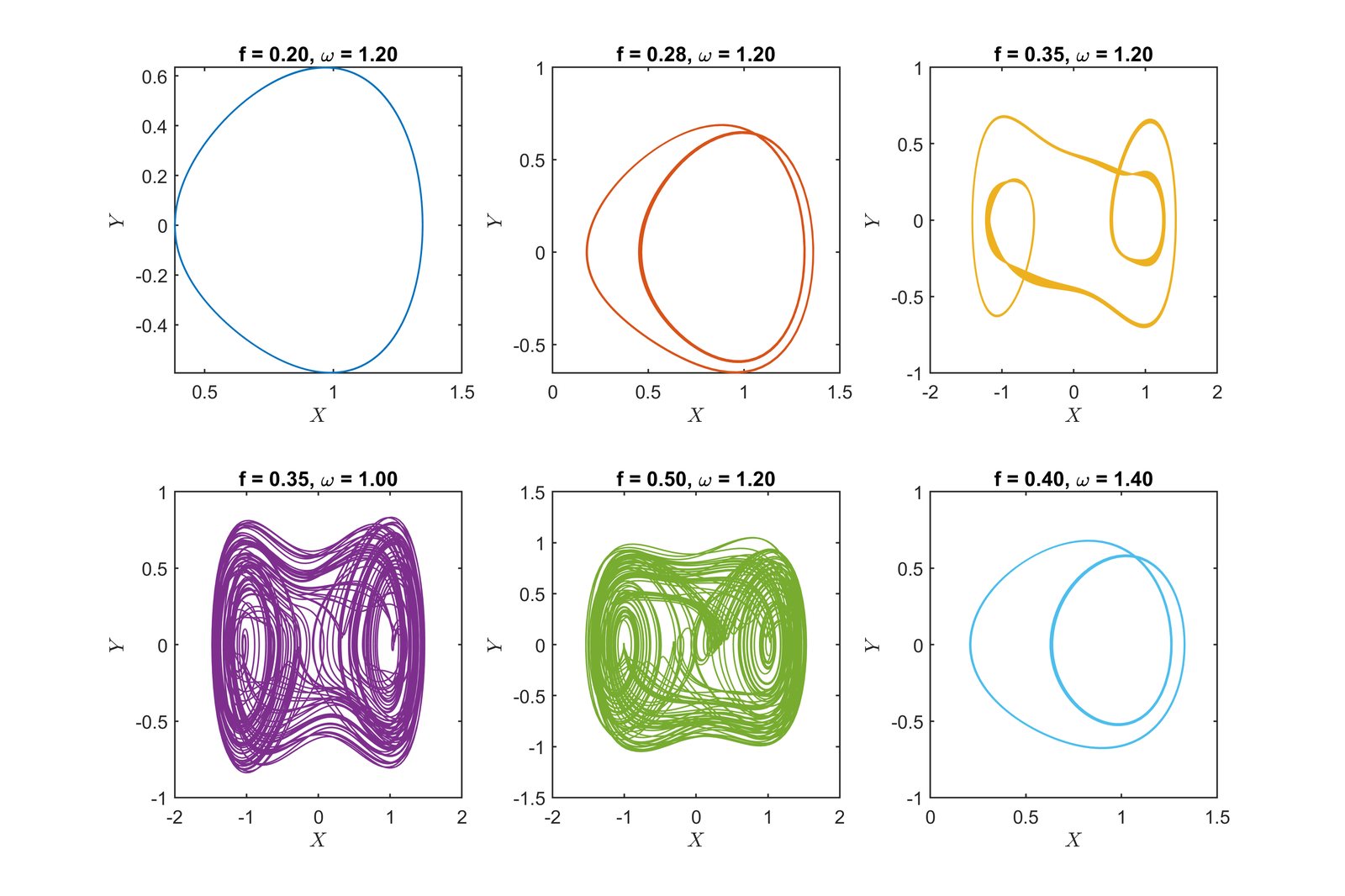
- Dynamics and stability. Phase-plane and bifurcation analysis, the route to chaos under periodic forcing (Poincaré sections, Lyapunov exponents, Melnikov theory), modulation instability and linear stability analysis.
- Computation. Symbolic derivations in Maple and Mathematica, numerics in MATLAB and Python, validation against discrete element simulations, and physics-informed neural networks for stochastic models.
Graduate direction. I want to put these results on firmer computational ground: numerical methods for fractional and stochastic PDEs that preserve the structure of their solutions, rigorous stability and error analysis of those schemes, and data-driven and physics-informed methods for models driven by real, noisy data.
Where it applies
Optics
Pulse propagation in mono-mode and dispersive fibre, through the Fokas, Schrödinger–Hirota and Davey–Stewartson models.
Magnetic materials
Short waves in zero-conductivity ferrites, through the stochastic Kraenkel–Manna–Merle and Konno–Oono systems.
Mechanics
Stress waves in granular metamaterials, from Hertzian contact to the Pochhammer–Chree equation, with earthquake-resistant design in view.
Beyond physics
The same toolkit applied to the fractional stochastic Ivancevic option pricing model, an econophysics setting.
Ongoing studies
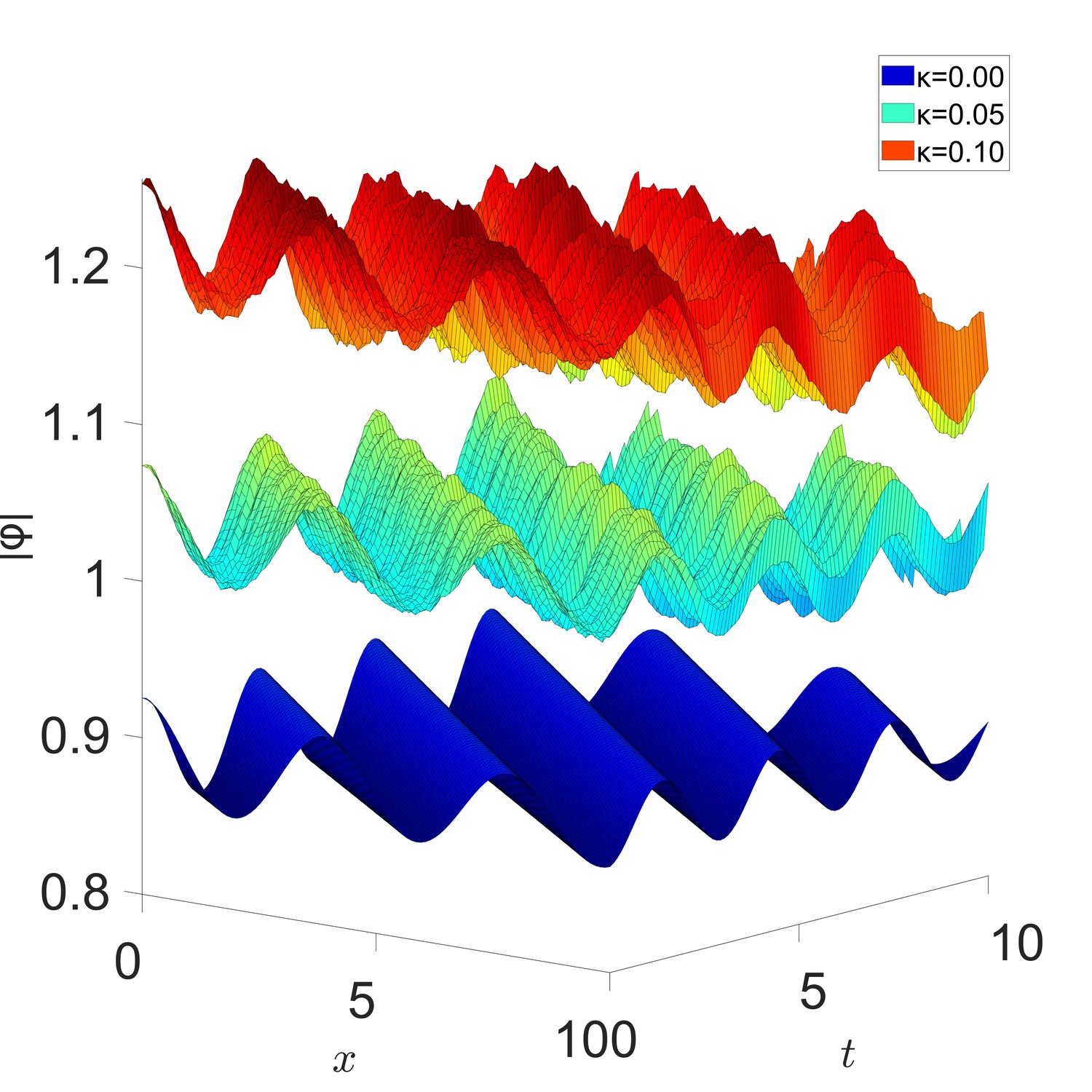
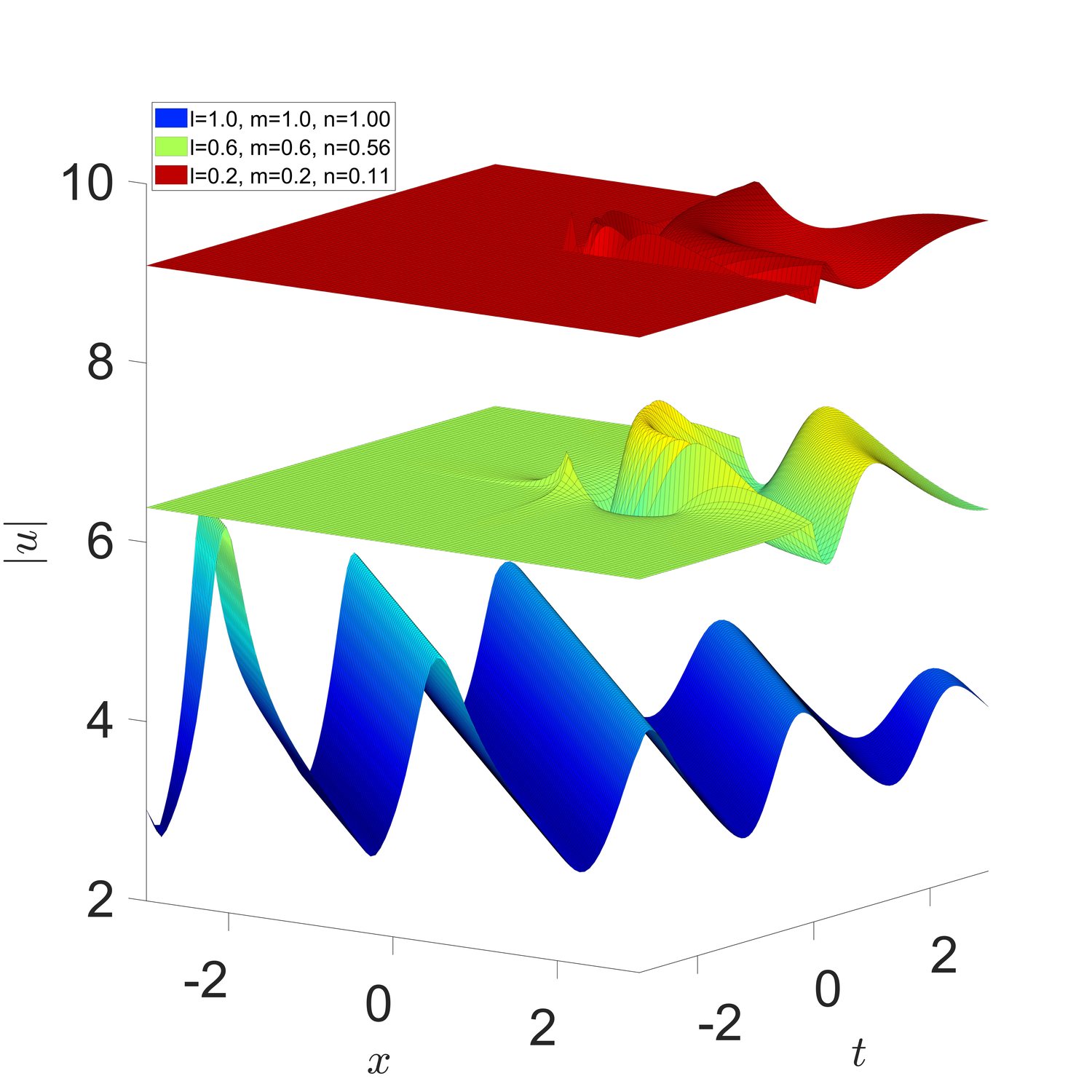
Simulations from work in progress: how noise intensity and fractional order reshape a wave, and how the same system slides into chaos when it is driven.