Tobibur Rahman
Publications
Five peer-reviewed journal articles, 2024 to 2026. Each figure below was made for this site to show the physics of the paper; the published figures are in the articles. Also on Google Scholar and ORCID.
-

Figure made for this site: (a) phase portrait of a planar system of the travelling-wave type, (b) chaotic orbit and Poincaré section under periodic forcing. Scientific Reports · 2026Solitons, bifurcation, chaos, and stability of the fractional Schrödinger–Hirota equation with beta derivative
Optical pulses in dispersive fibre, modelled by the Schrödinger–Hirota equation with a β-fractional derivative. The study derives new exact solitons and then asks a dynamical question: when does the system stop behaving regularly?
- Extended Riccati scheme yields kink, dark, periodic and mixed bright–dark solitons.
- Phase-plane and bifurcation analysis classify the equilibria; the fractional order acts as a bifurcation parameter.
- Periodic forcing drives a transition to chaos, measured with Poincaré sections and Lyapunov exponents; linear stability analysis confirms robustness.
-

Figure made for this site: a solitary pulse in a 70-bead Hertzian chain (force ∝ overlap^3/2), integrated numerically. Chaos, Solitons & Fractals · 2026 · open accessFrom Hertzian contact to Pochhammer–Chree dynamics: solitons, chaos, and bifurcation in granular metamaterials
A chain of elastic beads touching through Hertzian contact carries stress waves that no linear model captures. The paper connects the discrete Hertz law to a continuum Pochhammer–Chree equation with cubic nonlinearity.
- Bell-shaped, kink and compacton solitons from the improved auxiliary equation and improved tanh methods.
- Bifurcation analysis maps where solitary waves are stable; Melnikov's method predicts chaos under external forcing.
- Predictions checked against discrete element (DEM) simulations, with a positive Lyapunov exponent.
-

Figure made for this site: (a) how the β-derivative reshapes a bright soliton, (b) a two-dimensional solution at fixed time. Optical and Quantum Electronics · 2026Soliton solutions, chaotic dynamics, and stability analysis of the (2+1)-dimensional time–space fractional nonlinear Schrödinger equation
A two-dimensional nonlinear Schrödinger model with fractional derivatives in both space and time, relevant to optical pulse transport, plasma oscillation and fluid flow.
- β-fractional wave transformation and the extended Riccati method give periodic, anti-kink, bright, dark and bell-type solitons.
- Modulation instability analysis shows the solutions withstand small spatiotemporal perturbations.
- Bifurcation and phase-plane analysis reveal quasi-periodic and chaotic regimes.
-

Figure made for this site: (a) kink under noise σ = 0.6, (b) one noise realization against its mean damping e^(−σ²t/2). Optical and Quantum Electronics · 2024Comprehensive soliton solutions of fractional stochastic Kraenkel–Manna–Merle equations in ferromagnetic materials
Short magnetic waves in ferrites, modelled by a Kraenkel–Manna–Merle system that carries both memory (conformable derivative) and randomness (multiplicative Brownian noise). My contribution covered software, data curation, formal analysis and writing.
- Enhanced rational (G′/G)-expansion and improved tanh schemes produce periodic and kink soliton families.
- Graphical study of how noise intensity σ and fractional order α reshape each family.
-

Figure made for this site: an illustrative (2+1)-dimensional optical soliton ridge, as a surface and from above. Optical and Quantum Electronics · 2024 · open accessExclusive soliton solutions arise in mono-mode optical fibre connecting to nonlinear Fokas system
The (2+1)-dimensional Fokas system describes nonlinear pulses in mono-mode optical fibre, with separate parameters for dispersion, nonlinear coupling, transverse dispersion and saturation.
- Improved auxiliary equation and improved tanh schemes give a large family of new optical soliton solutions.
- 3D, 2D and contour studies show how each physical parameter changes the pulse.
Talks
- Jun 2026
Bifurcation, chaos and soliton dynamics in the fractional stochastic Ivancevic option pricing model: an econophysics perspective
Oral presentation, International Conference on Emerging Frontiers in Advanced Sciences and Technologies (EFAST 2026), Pabna University of Science and Technology. With M. T. Islam and M. A. Akbar
- Dec 2025
AI-driven analysis of the fractional stochastic Davey–Stewartson model in optical fibres, using analytical methods and physics-informed neural networks
Oral presentation, 24th International Mathematics Conference (24IMC 2025), University of Chittagong. With S. B. S. Jyoti, S. Ryehan and M. T. Islam
- Feb 2025
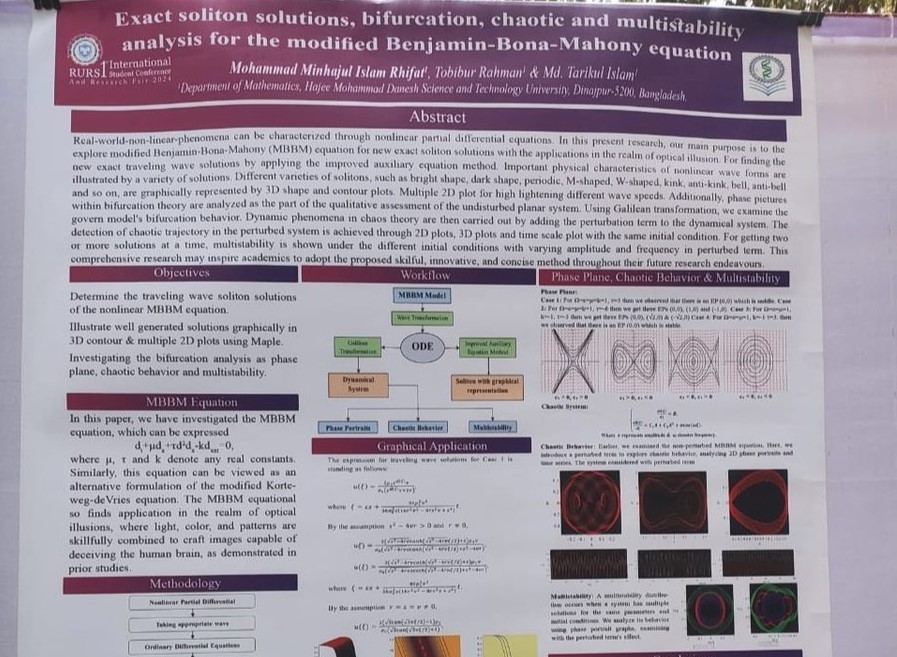
Exact soliton solutions, bifurcation, chaotic and multistability analysis for the modified Benjamin–Bona–Mahony equation
Poster, RURS 1st International Student Conference and Research Fair, University of Rajshahi. With M. M. I. Rhifat and M. T. Islam
- Feb 2025
The analytical solitary wave solutions and bifurcation analysis of the space–time fractional stochastic Yu–Toda–Sasa–Fukuyama equation, across conformable, beta and M-derivatives
Oral presentation, 3rd National Mathematics Conference 2024, BUET, Dhaka. With M. M. I. Rhifat, M. H. Ifti and M. T. Islam
- Dec 2023
Outstanding soliton solutions of the stochastic Konno–Oono model arising in a magnetic field with noise effects
Oral presentation, 1st National Conference on Advances in Science and Technology, BUET, Dhaka. With S. Ryehan and M. T. Islam
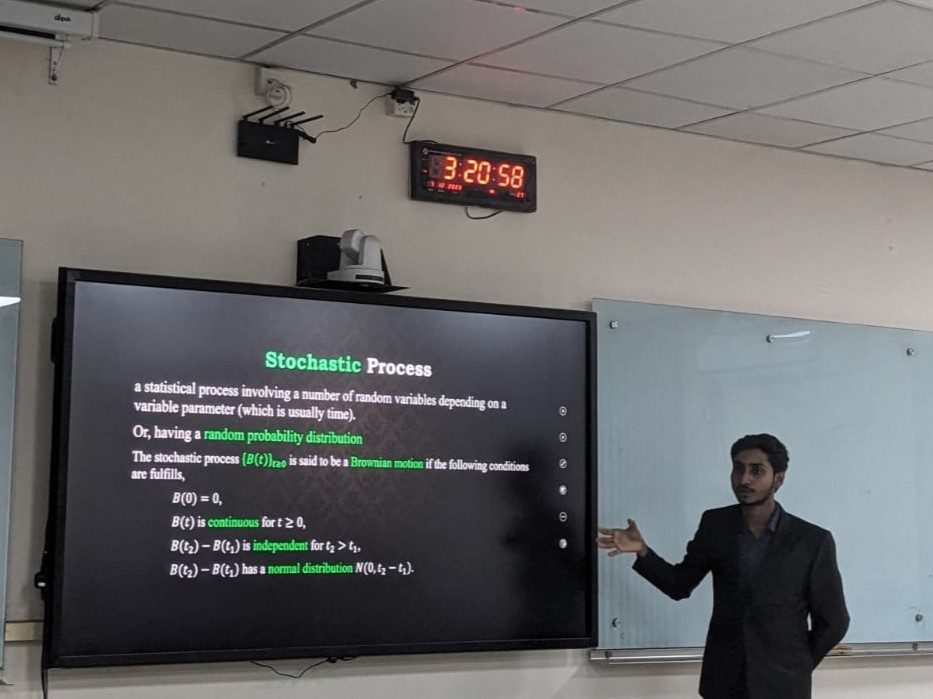
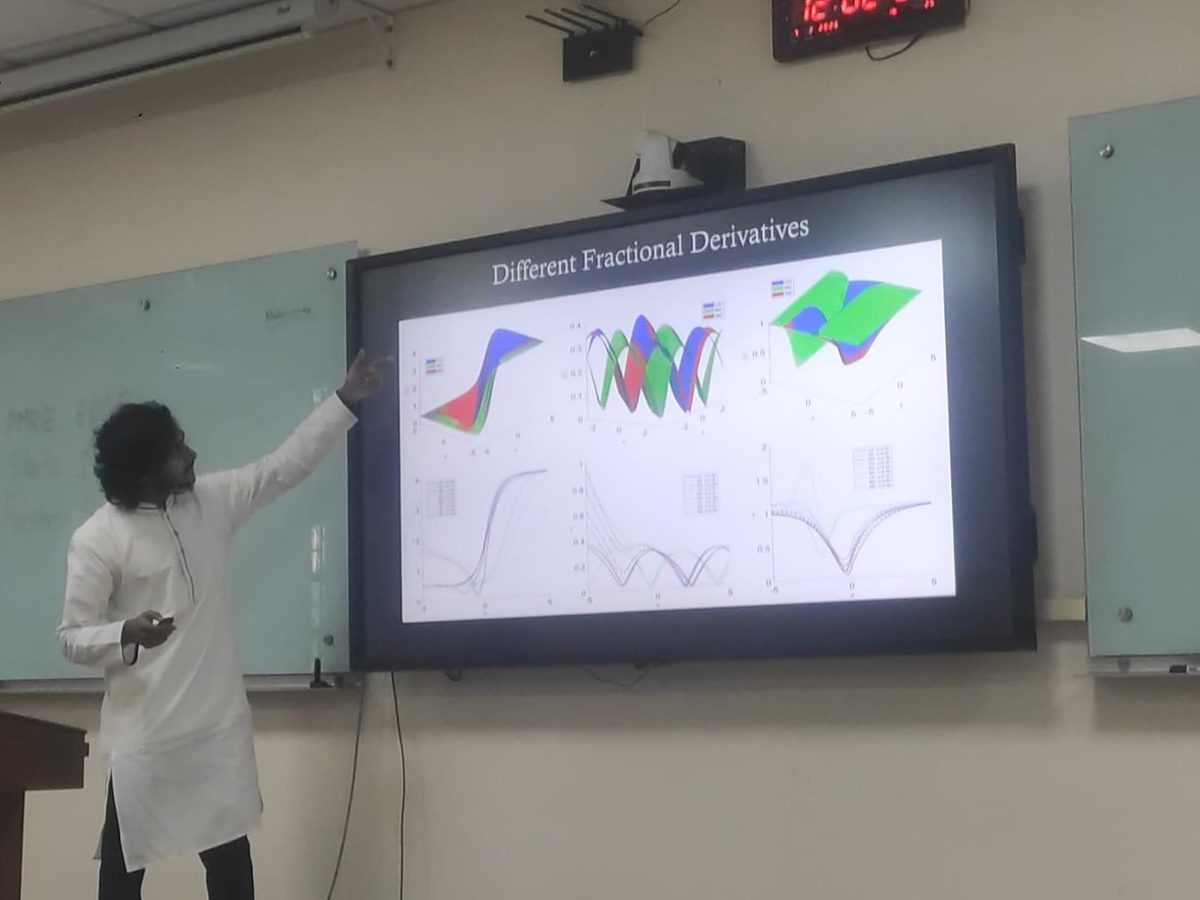
In the room
Presenting the work at conferences in Pabna, Dhaka and Rajshahi, from 2023 to 2026.